
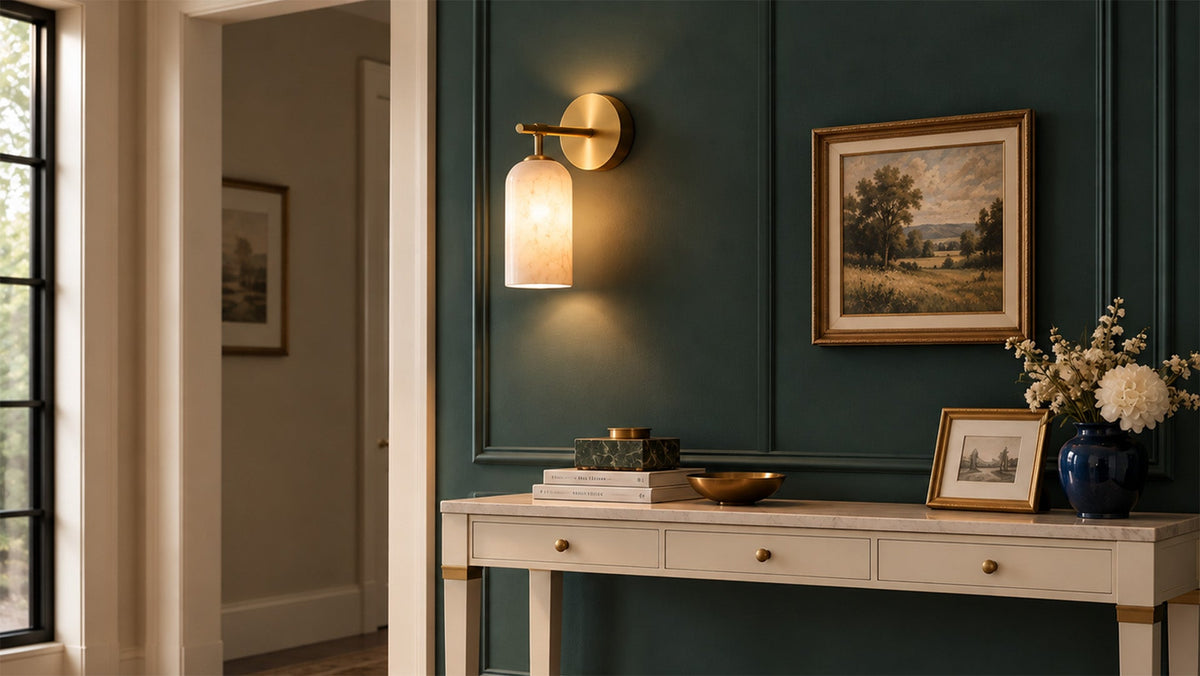
A more beautiful home is rarely made by adding one more lamp, pendant, or row of ceiling spots. In refined rooms, lighting is edited. Glare is cut, sources are hidden or softened, and darkness is allowed to shape the space. This guide shows how light filtering, light absorption, light physics, and light control can work as design tools, not as a shopping list.
This is why the idea behind “Your home doesn’t need another lamp; what it needs is a subtraction of light.” matters. The goal is not a dark home. It is a calmer one, where the eye can rest and the room can be seen without noise.
What does it mean to subtract light?
To subtract light is to remove, soften, block, diffuse, absorb, or redirect light so the room feels calmer and more clear. It does not mean making a home dark or hard to use. It means not using another fixture for every problem.
Most people learn to think of lighting as an addition. A room feels dim, so they add a lamp. A corner feels flat, so they add a spotlight. A kitchen is renovated, so the ceiling gets a grid of recessed lights, a pendant over the island, under-cabinet strips, and maybe decorative sconces too. Some of those choices help. But if they are added without order, the room feels crowded.
The better question is not, Where can I put another light? It is, Which light is doing too much? That is where subtraction helps. You start to notice glare on shiny surfaces, hard shadows under shelves and cabinets, exposed bulbs in direct view, and ceiling lights that flatten everything below them. When those things are reduced, the room feels richer without needing to cost more.

Renovation lighting is often treated like a checklist
In many home renovations, lighting is treated like a task list, not a visual language. The main bedroom gets a central fixture. The hallway gets downlights. The dining area gets a pendant. The kitchen gets task lights, island pendants, recessed ceiling lights, and maybe a decorative fixture. Bathrooms get vanity lights, ceiling lights, and sometimes a small statement light if there is room.
This checklist feels safe. It gives each room a known category: main light, task light, accent light, decorative light. Contractors and homeowners can look at the plan and feel sure that nothing was missed. A flush-mount in the laundry room, sconces by a mirror, and recessed lights in the living room all seem to prove the job is done.
But done is not the same as refined. A home can have every standard fixture and still feel restless. The problem is rarely the fixture type itself. The problem is that the lights are chosen as separate tasks, not as one scene.
A checklist asks, Do we have enough light? A better question is, What should be seen, what should stay quiet, and where should the room be allowed to fade back? That is where light manipulation becomes more subtle. You stop lighting every plane the same way, and you start choosing what deserves attention.
The exquisite room has fewer lighting arguments
The key to fine lighting is removing lights that do not help, not adding more. More fixtures can make a room brighter, but restraint makes it feel calmer. High-end lighting is not defined by how many fixtures appear in the ceiling or how much they cost; it is defined by how smartly they disappear, soften, or support the room.
This matters because many rooms grow less elegant as they grow more lit. Too many ceiling spots make little cones of attention everywhere. Exposed bulbs compete with one another. Decorative lights in every room can feel like jewelry worn all at once. Each piece may be good on its own, but together they tire the eye.
A restrained room has order. One warm sconce may wash a wall. A shaded lamp may pool light beside a chair. A hidden strip may lift a shelf while the ceiling stays quiet. Nothing shouts for control. The room feels rich not because it is full of costly objects, but because it knows silence.
This is why the phrase “Your home doesn’t need another lamp; what it needs is a subtraction of light.” is more than a clever line. It shifts the whole lighting talk. The issue in many homes is not too little light. It is too little editing.
Restraint is not the same as plainness
Subtraction does not mean a bare room, a white room, or a dry design style. A layered home can still use soft lighting. In fact, restraint matters more when a room has pattern, texture, books, art, antiques, plants, or deep color.
The more visual material a room holds, the more carefully light must be controlled. Otherwise every object gets the same push, and the room loses depth. Subtractive lighting lets some things step back so the most important ones can come forward.
Visual noise begins when every light wants attention
Visual noise is clutter made not only by objects, but by brightness, glare, reflections, shadows, and visible fixtures fighting for notice. In lighting, it often shows up as too many ceiling holes, too many exposed bulbs, too many reflections in glass, or too many decorative lights all trying to be the center.
This is why fewer well-placed lights often feel more refined than many scattered ones. A pair of wall sconces can give a room rhythm, human scale, and soft side light. Ten ceiling spotlights may give the same room coverage, but they can also make the ceiling look busy and the room feel more like a shop than a home.
Wall sconces help because they take pressure off the ceiling. Instead of sending all light down in a grid, they place it near the level where people live: faces, art, shelves, doorways, textured walls. When a sconce is shaded, diffused, or aimed away from the eye, it can make a soft field of light instead of a hard beam. That softness is often read as elegance.
Ceiling lights are not the enemy. A room may still need overhead light for cleaning, cooking, safety, or flexibility. But when the ceiling becomes the answer for every corner, the home loses warmth. A more graceful room lets light come from the side, from below eye level, behind objects, or through a filtered surface.
Signs a room has too much visual noise
Use this checklist to sharpen your eye, not as a strict rule:
· The ceiling is busy. Recessed lights, pendants, vents, speakers, beams, and smoke alarms all ask for attention.
· Every fixture shows at once. The room has no order because each source speaks equally.
· Faces look harsh or lost in shadow. Downlights may be bright on tables and floors while people look flat or tired.
· Shiny surfaces glare. Stone, glass, lacquer, mirrors, and polished metal reveal weak light control fast.
· The room feels bright but not warm. Light is present, but mood is missing.
· Decorative lights do not work together. Pendants, lamps, and sconces may all look nice alone, but still fail as one scene.
When you spot these signs, the fix is rarely another fixture. The better move is usually to dim, shade, redirect, or remove the source causing the most strain.
Light physics belongs in everyday rooms
Light physics may sound technical, but the basic ideas are simple and useful. Light travels, reflects, scatters, absorbs, and changes based on the materials it touches. A good room is not just lit by fixtures. It is lit by the talk between light and surface.
A bare bulb sends light out directly and often causes glare. A fabric shade filters it. A matte wall scatters it more gently than a glossy one. A dark rug absorbs more light than a pale floor. A translucent stone-like shade, such as an alabaster-style diffuser, softens the source so the eye sees glow instead of sharp brightness. These physical effects shape how a room feels.
Light filtering is one of the most useful ideas for home interiors. A filtered source passes through a material that cuts harshness and spreads the light. Curtains, shades, frosted glass, paper lanterns, fabric lampshades, and alabaster-style fixtures all do this in different ways. The result is not just less brightness. It is a different kind of brightness.
Light absorption matters too. Darker and more textured materials absorb more light, which can create intimacy and depth. That is why a deep-colored dining room can feel rich under soft sconces, while the same room under strong overhead light may feel heavy or theatrical. Absorption is not a flaw. It is one way a room gains mood.
The role of reflection, diffusion, and shadow
Reflection sends light back into the room. Diffusion scatters light so it is less direct. Shadow gives objects shape and gives the room depth. Good lighting balances all three.
If everything reflects, the room can feel glaring. If everything absorbs, it can feel dull or relatively underlit. If everything is diffused, it may feel pleasant but a bit flat. If shadows are too hard, the room can feel dramatic in a way that is not easy for daily life. The art is in choosing which effect belongs where.
A reading corner may need a clearer pool of light. A hall may benefit from a soft wall wash. A bedroom may need low, warm, diffused sources more than a bright center fixture. A kitchen may need task light, but even there, not every source needs to be visible or intense.
Why does diffused light feel better for daily living?
Diffused light feels better for daily life because it softens contrast, cuts glare, and gives the eye a calmer place to land. Most daily tasks do not need sparkle. They need comfort, direction, and ease. That is why soft light from alabaster-style fixtures often fits everyday life better than the sharp, faceted shine of a crystal chandelier.
A crystal chandelier can be beautiful in the right room. It is often made to refract, sparkle, and make points of light. That can add ceremony to a dining room, a foyer, or a formal space. But the same quality that makes it dramatic can also make it demanding. Faceted light grabs attention, multiplies highlights, and can feel busy even when the room is still.
Alabaster-style diffusion works in the opposite way. Instead of breaking light into glittering bits, it gathers and softens it. The fixture becomes a glowing form instead of a set of sharp points. For daily living, that softness is often easier to live with. It flatters faces, smooths the shift from day to evening, and makes simple routines feel less exposed.
This is not about saying one material is better than another. It is about fit. A chandelier that feels magical at dinner may feel too strong on a quiet Tuesday night. A diffuse fixture may be less dramatic, but it can make a room feel better for more of the day.

Subtractive color is a useful metaphor for interiors
Subtractive color is what happens when pigments, dyes, or filters absorb some wavelengths and reflect or send back others. In simple terms, color appears because some light is removed. A red fabric looks red because it absorbs much of the other light and reflects red back to the eye.
That idea is a good metaphor for interiors. The feeling of a room is shaped not only by what is added, but by what is held back. A shaded lamp with a warm liner cuts glare. A curtain filters daylight and lowers contrast. A matte wall absorbs brightness that might bounce too hard. A dimmer lowers output so materials can breathe.
Subtractive color also reminds us that light and material are linked. Paint, wood, stone, metal, fabric, and glass all change light. A white room with strong downlights behaves differently from a burgundy room with shaded sconces. The fixture matters, but so does the surface it lands on.
This is why good lighting choices cannot be made in isolation. You are not just choosing brightness. You are choosing how brightness is changed by the room.
Light control creates atmosphere before decoration does
Light control means deciding where light goes, where it does not go, how strong it is, how visible the source is, and how it changes over time. It includes dimming, shielding, filtering, aiming, spacing, layering, and sometimes switching lights off completely. In refined homes, light control often matters more than the fixture itself.
A room with one shaded lamp, one dimmed wall sconce, and good daylight can feel more thought out than a room full of expensive statement pieces. The eye reacts to relationships, not price tags. Brightness beside darkness, matte beside glow, hidden source visible object: these contrasts make atmosphere.
High-end lighting is about restraint, not expense. An expensive fixture placed without thought can still create glare, clutter, or imbalance. A modest fixture used with care can feel graceful because it supports the room instead of trying to rule it. Price does not make lighting smart. Judgment does.
A more refined way to evaluate a room
Instead of starting with products, start with what you see:
1. Stand at the entry. Notice what your eye sees first. If it is a bulb, a ceiling grid, or glare, the light may be too bold.
2. Look at the walls. Walls often carry mood better than floors. A softly lit wall can make a room feel larger, calmer, and more spatial.
3. Watch faces. Homes are for people. If the light flatters objects but makes people look tired, the order is wrong.
4. Check reflections. Mirrors, night windows, framed art, stone counters, and glossy tables show poor light control fast.
5. Turn lights off one by one. This is the best test of subtraction. If the room improves when a light is off, that source needs a recheck.
6. Notice quiet corners. Not every corner needs the same level of light. A little darkness can make the lit parts feel more meaningful.
This simple test builds taste. It moves your focus away from buying fixtures and toward seeing what light is doing.
The ceiling is often overburdened
Modern homes often ask the ceiling to do too much. It holds recessed lights, pendants, fans, speakers, vents, skylights, alarms, beams, and sometimes moldings. When every lighting choice is pushed upward, the ceiling stops feeling calm and starts feeling technical.
That is one reason many rooms with lots of recessed lights feel less like homes than they should. Downlights can be useful, but they tend to push brightness downward and leave walls relatively dull. Used too much, they turn a living room into a display space instead of a place to settle.
A better way is to spread light through the room. Side light from sconces, low lamps near seating, hidden shelf light, and filtered daylight all reduce pressure on the ceiling. The room gains depth because light arrives from more human places, not from one overhead source.
This does not mean cutting every ceiling fixture. It means giving the ceiling fewer jobs. Let it provide general support when needed, but do not make it carry mood, task light, decoration, and drama all at once.
Darkness is not a failure of design
Many people fear darkness in interiors because they link it with neglect or trouble. But darkness, used on purpose, is one of the most important parts of good lighting. Without darkness, there is no glow. Without shadow, there is no depth. Without restraint, there is no sense of arrival.
A softly lit room depends on contrast. The shaded side of a vase, the dim corner past a chair, the darker upper wall above a sconce: these areas make the lit parts feel stronger. If every surface is equally bright, the room may be easy to see, but it will not always be memorable.
This is especially true at night. Daylight is open and even; it can fill a room with little effort. Evening light should be more selective. It should not try to copy noon. It should help the home move toward rest, talk, cooking, reading, and quiet.
The discipline of subtraction lets evening feel like evening. It gives the home rhythm.
A practical framework for subtractive lighting
Subtractive lighting is not a buying guide. A way of seeing. The point is not to chase one fixture type, one material, or one trend. The point is to see how each source changes the room.
Use this framework when you look at an old space or plan a new one:
· Purpose: What must be clearly seen for safety, comfort, or use?
· Order: Which surfaces or objects should get attention, and which should step back?
· Source visibility: Is the bulb, opening, or shade adding beauty, or just distraction?
· Direction: Does light come only from above, or does it also come from the side and through bounce?
· Texture: Are matte, porous, or fabric surfaces helping absorb and soften light?
· Filtering: Could a shade, curtain, diffuser, or indirect bounce improve the light?
· Control: Can the light be dimmed, switched apart, or turned off without making the room hard to use?
· Silence: What happens when one light is removed from the scene?
The last question matters most. Good lighting often improves through removal. You do not know which lights are needed until you see the room without the ones that are not.
The hierarchy of a calmer room
A calmer room usually has three layers, but they do not have to be equal. First, there is enough general light to move safely. Second, there are clear pools of light for reading, cooking, dressing, or gathering. Third, there is mood light that gives the room tone.
The mistake is making all three layers equally bright and equally visible. The better choice is to let one layer lead and let the others support. In a living room, mood may lead. In a kitchen, task light may lead during prep, then step back at dinner. In a bedroom, low and diffused light may matter more than broad overhead coverage.
Layering is not buildup. Layering is orchestration.
The most elegant light is often the least obvious
Beautiful lighting rarely asks to be admired on its own. It helps you admire the room, the people in it, and the life happening there. It may come through linen, skim across plaster, glow through stone, hide behind a shelf, or rest quietly under a shade.
This is the deeper promise of subtraction. When the extra lights are removed, the remaining light matters more. A single sconce can feel clear. A dim lamp can feel close. A shadow can feel safe rather than sad.
High-end lighting is not about collecting more impressive fixtures. It is about editing brightness until the home feels balanced. The result is not less beauty. It is more room for beauty to be noticed.
Q&A
Question: Does subtracting light mean making a room darker?
Short answer: No. It means making light more controlled, more useful, and more comfortable. A room can still be safe and practical while using fewer visible sources, less glare, better diffusion, and stronger contrast.
Question: What is the first step in subtractive lighting at home?
Short answer: Turn lights off one by one and watch what happens. If the room feels calmer, warmer, or more composed when one fixture is off, that light may need dimming, shading, redirecting, or removal.
Question: Why are wall sconces often better than only using ceiling lights?
Short answer: Wall sconces bring light to human scale. They light faces, walls, art, shelves, and doorways instead of just pushing brightness downward. When they are shaded or diffused, they often feel softer and more intimate than a ceiling grid.
Question: How do materials change the quality of light in a room?
Short answer: Materials change light by reflecting, diffusing, filtering, or absorbing it. Matte walls scatter light gently, glossy surfaces can glare, fabric shades filter harshness, and darker textures absorb light to create depth and mood.
Question: Is expensive lighting needed for a high-end look?
Short answer: No. High-end lighting depends more on judgment than price. A simple shaded lamp or dimmed sconce can feel more elegant than a costly statement fixture if it supports the room, cuts visual noise, and creates atmosphere.
Share: