

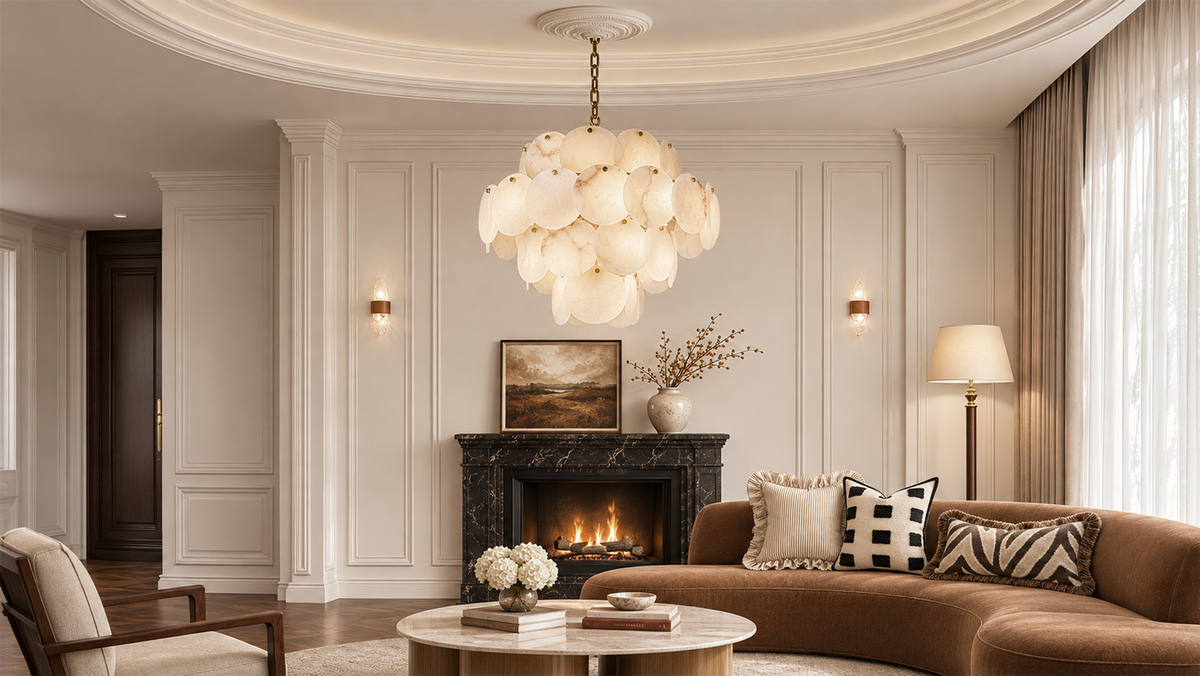
Why alabaster lighting makes a home feel alive is easy to see in a room that needs a softer focus. The stone turns light into a calm glow and gives the space something to notice without taking over. Choose alabaster lamps, pendants, or an alabaster chandelier to add a warm focal point with natural marks and character. Start with the space you want to enjoy more, then find the form that fits there.
Find your starting point: a bedside lamp, an overhead pendant, or a centerpiece above the dining table.
What makes alabaster lighting feel different?
Alabaster is a natural stone that lets light pass through it. It shows soft cloudlike marks and veining. When used as a lit shade, it softens the light instead of simply hiding the bulb. That mix of stone and light gives the fixture its own presence, even in a room that is otherwise plain.
Picture a living room you like in daylight but rarely settle into after dinner. Instead of starting with new furniture, picture a glowing stone shade beside your favorite chair. The point is simple: make that corner a place you actually want to spend the evening.
The appeal is not perfect sameness. Natural alabaster varies in color and texture, so its marks should be part of your choice, not an afterthought. Choose it when you want the material itself to shape the design.


Tricolordeer Alabaster Petal Chandelier
Handcrafted genuine alabaster petal silhouette with polished brass hardware. Casts a warm, diffused luminescence that turns any living or dining space into a serene sanctuary.
Find the form that fits your everyday life
Begin with what happens in the room, not with the fixture alone. A bedside surface, a kitchen island, and a dining table each suggest a different starting point. Use those situations to narrow your search before you compare individual designs.
- Alabaster lamps for a bedside or console: Use a table lamp when your plan centers on an existing surface. Check its footprint against the things you need close by, like books, a water glass, or a place for your keys.
- Alabaster pendant lighting for an overhead focal point: Use a single pendant or a small group when you want to highlight one area. Plan the placement around the table, counter, or seating below it, not as if the ceiling were a separate scene.
- An alabaster chandelier for a central statement: Use a chandelier when you want the overhead fixture to be part of the room's identity. Compare its shape with your furniture layout, and decide whether you want a tight silhouette or a larger form.
You do not need to repeat alabaster throughout the house. Start with one spot where the fixture has a clear job. A careful choice is more useful than a matching set bought before you know what each room needs.
Let the stone provide the detail
Alabaster's natural marks give you a reason to look closely. Makers describe changes in veining, form, and color as normal, so two pieces should not be expected to match. If you are choosing several fixtures, treat them as related pieces rather than exact copies.
For a calm scheme, choose a simple fixture shape and keep the space around it clear. If your room already has patterned fabric or bold art, decide whether the lighting should hold its own or take a quieter role. The goal is a look you enjoy, not a rule that every material must match.
Review the fixture both lit and switched off before you decide. Stone lighting changes when it is on, and its soft glow and veining become part of the look. Look for a piece whose daytime presence appeals to you as much as its evening glow.


Tricolordeer Cluster Alabaster Spheres Chandelier
Lathed from 100% natural quarried alabaster spheres with customizable independent cable suspension. An architectural statement piece for spiral stairwells and double-height entries.
Make your shortlist practical
A beautiful photo is a starting point, not a full spec. Before you commit to a fixture, gather the details that connect its look to your real room. Use this checklist to make your next talk with the seller more useful.
- Record the available space: Measure the surface, furniture, and ceiling area involved. Keep those numbers beside the product dimensions so you are comparing the fixture with your home, not just its photo.
- Describe the job: Decide whether you want an atmospheric accent, light for a specific task, or an overhead centerpiece. Ask for the product's light output details instead of assuming its look tells the whole story.
- Confirm the lighting controls: Ask whether the fixture is dimmable and what compatible equipment it needs. Treat those details as product-specific facts to check before you buy.
- Check the material description: Confirm which parts are natural alabaster. Ask for clear views of the stone and what kind of variation to expect in the piece you receive.
- Clarify installation and care: Obtain the mounting requirements and maker's maintenance instructions. Make those part of your choice, especially when comparing a table piece with a hanging fixture.
Keep your shortlist focused on the room you are working on now. If two designs appeal equally, return to the everyday scene: which one better supports the way you want to use that space?
Bring your room into the decision
Choose the spot first. Take a photo, note the measurements, and write down what feels missing: a welcoming bedside corner, a defined dining area, or a focal point you enjoy looking at.
Then compare alabaster lamps, pendant lighting, and chandelier designs against that brief. You are not choosing an object for an empty photo; you are choosing something to live with.
Shortlist your preferred fixture and request its product details before you buy.
Share:
Living Room Lighting Makeover: Layered Light Tips